Tile Roof Repair in Shaw, NoMa & Bloomingdale, Washington DC

Shaw sits at the crossroads of Northwest and Northeast Washington, D.C. — a neighborhood defined by late-19th-century rowhomes, Wardman-era brick facades, and ornamental mansard rooflines clad in barrel and flat clay tiles. DC Tile Roof Repair dispatches from our headquarters at 1679 7th St NW, directly inside the Shaw historic district.

ZIP 20001 ZIP 20013 ZIP 20038 ZIP 20044 ZIP 20045 ZIP 20055 ZIP 20062 ZIP 20066 ZIP 20073 ZIP 20074 ZIP 20090 ZIP 20091

DC Licensed & Insured

Full liability coverage

Historic Tile Salvage

Vintage & discontinued tiles

Transparent Estimates

Itemized pricing

24/7 Emergency Dispatch

Rapid leak response across DC

Why Shaw's Tile Roofs Require Specialized Attention

Shaw's residential stock stretches from the post-Civil War reconstruction period through the early 1930s. Many properties along 7th Street NW, S Street NW, and around Logan Circle were constructed during a building boom that introduced ornamental clay tile to Washington, D.C. on a significant scale. Developers like Harry Wardman specified terracotta barrel tiles on front-facing mansard slopes to add visual distinction to otherwise uniform brick facades.

What makes tile repair in Shaw different from other DC neighborhoods is the density of the built environment. These rowhomes share party walls, meaning that water intrusion from a failing tile roof on one property can migrate through shared masonry into adjacent structures. A single ridge cap that has lost its mortar bedding can create moisture pathways that affect multiple homes along a block.

The DC Historic Preservation Office designates portions of Shaw within the Greater U Street Historic District. Any exterior roof work on properties within this boundary must use materials visually consistent with the original construction. This means replacement tiles must match the original profile, colorway, and surface texture — standard mass-produced concrete tiles will not satisfy review requirements.

Wardman Mansard Tiles on 7th Street NW

Our headquarters sits on 7th Street NW, surrounded by the very Wardman-era rowhomes we specialize in restoring. The barrel tiles on these mansard slopes are typically green-glazed or natural terracotta clay, installed between 1910 and 1930.

Party Wall Water Migration

Shaw's attached rowhome construction means a failing tile roof affects neighboring properties. We assess not only the damaged slope but also inspect adjacent party wall flashing details to prevent moisture transfer through shared brick walls.

Shaw Service Area Details

Coverage: Shaw, NoMa, Bloomingdale, LeDroit Park, Truxton Circle, Eckington (south), Mount Vernon Triangle
Streets: 7th St NW, Rhode Island Ave NW, New Jersey Ave NW, Florida Ave NW, North Capitol St
HQ Distance: On-site — our headquarters at 1679 7th St NW is located in Shaw
Primary ZIP: 20001 (residential deliverable)
Call Shaw Office: (833) 896-1555

What We Handle on Shaw Tile Roofs

Our scope of work in Shaw addresses the specific failure mechanisms found on century-old clay tile roofs in dense rowhome configurations.

Wardman Mansard Clay Tile Restoration

The ornamental front mansard is the defining architectural feature of Shaw's Wardman rowhomes. These steep slopes (typically 70° to near-vertical) create unique repair challenges. Tiles on mansard planes bear significant gravitational pull and rely heavily on mechanical fastening and mortar wedges rather than gravity overlap alone. We replace fractured mansard tiles using rope-access techniques that avoid damaging adjacent sound units on these tightly-packed slopes.

  • Steep-slope mansard tile replacement using rope safety systems
  • Matching green-glazed and natural terracotta Wardman-era tiles
  • Mortar wedge renewal on vertical and near-vertical tile courses
Request An Estimate

Ridge & Hip Mortar Repointing

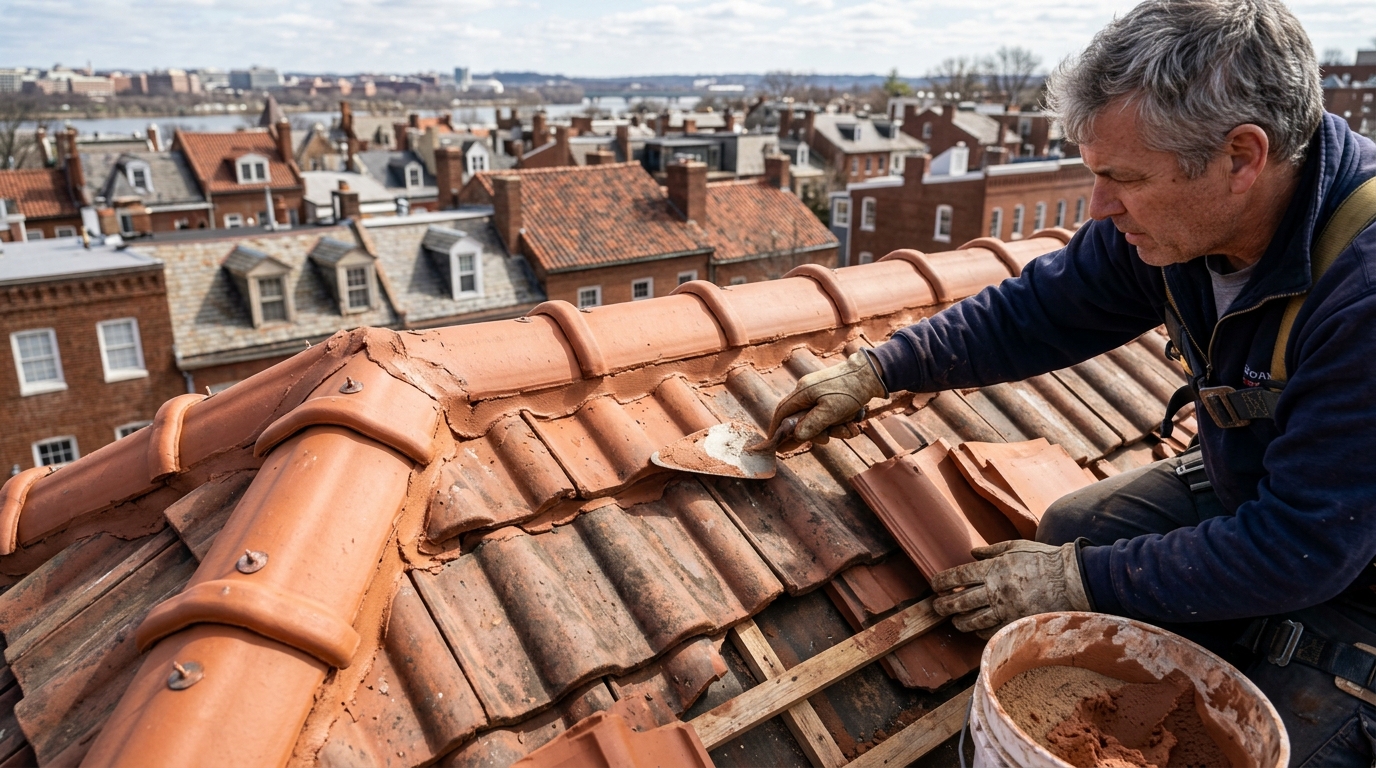
Along the roofline ridges of Shaw's attached rowhomes, mortar bedding is the primary structural anchor holding ridge caps in place. Washington's freeze-thaw cycle is particularly destructive to mortar at this elevation because ridge caps receive maximum exposure to rain, wind, and temperature swings. We chisel out failing mortar and apply polymer-modified roofing mortar that flexes with seasonal thermal movement instead of cracking.

  • Complete ridge mortar removal and polymer repointing
  • Mechanical screw anchoring for ridge tiles on rowhome ridges
  • Color-matching mortar to blend with original brickwork
Request An Estimate

Party Wall Flashing & Waterproofing

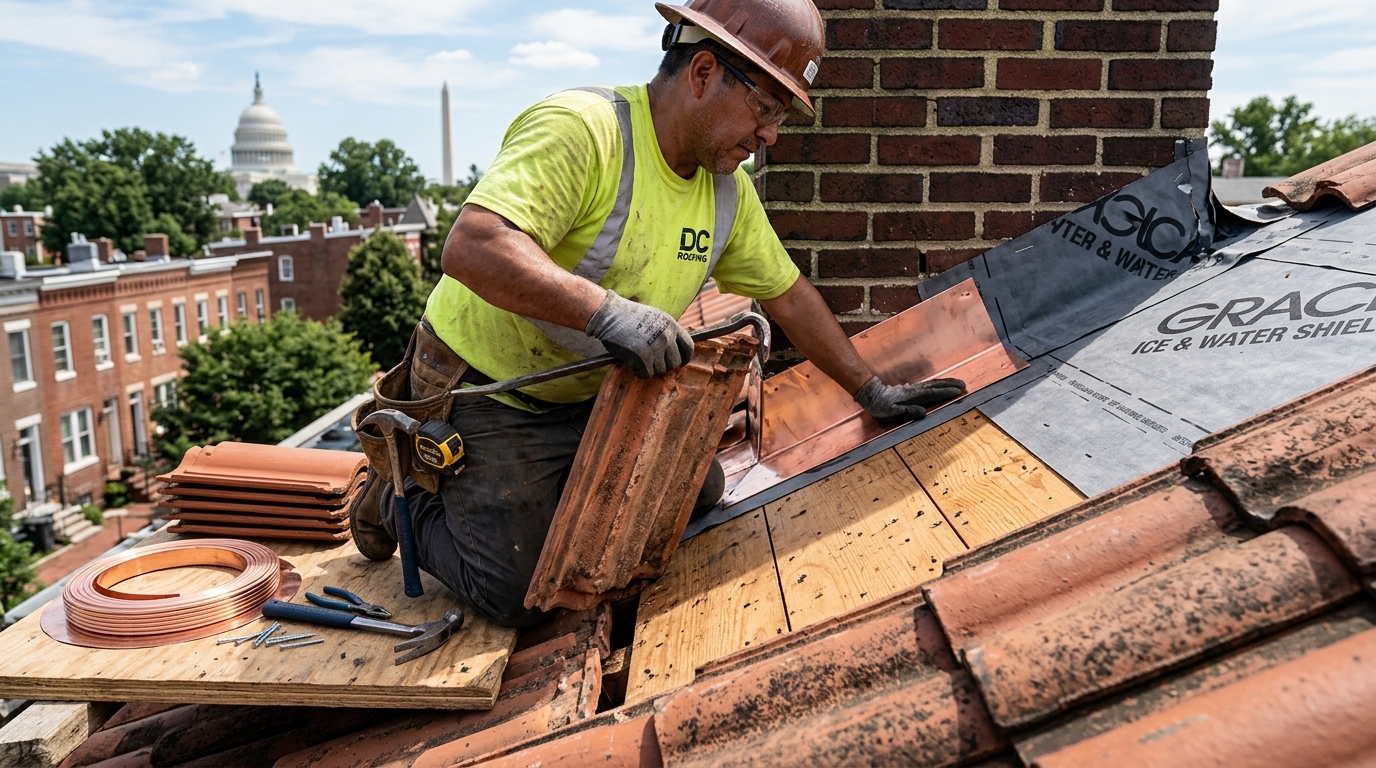
Rowhome party walls are a persistent leak source in Shaw. Where a tile roof terminates against a shared brick wall, step flashings must be properly embedded into mortar reglets. Over decades, these lead or copper counter-flashings pull away from the masonry as the building settles. We re-cut masonry reglets, fabricate new copper counter-flashings, and seal the party wall junction to stop cross-wall water migration that damages both your property and your neighbor's.

  • Masonry reglet cutting and copper counter-flashing installation
  • Self-adhering membrane at party wall roof transitions
  • Preventing neighbor-to-neighbor moisture migration
Request An Estimate

How Shaw's Urban Heat and Winter Cycling Affect Tile Roofs

Shaw sits in one of Washington, D.C.'s densest urban corridors. The combination of brick buildings, concrete sidewalks, and asphalt streets creates a pronounced urban heat island effect. During summer months, roof surface temperatures in Shaw regularly exceed 150°F on south-facing slopes — roughly 10 to 15 degrees hotter than homes in less dense, tree-shaded neighborhoods like Cleveland Park or Chevy Chase.

This extreme heat accelerates the oxidation of asphalt-saturated underlayment felt beneath the tiles. Where a well-shaded tile roof might see its underlayment last 30 to 35 years, an exposed Shaw rowhome roof often needs membrane renewal within 20 to 25 years. The intense solar radiation also dries out mortar bedding on ridge caps faster than in less exposed areas.

In winter, Shaw's urban canyon effect creates a different problem. Wind channels between rowhome blocks accelerate wind speed across exposed ridge lines, increasing the lift force on mortar-bedded ridge caps. The combination of weakened mortar (from summer heat damage) and increased winter wind loads means ridge cap failure is more frequent in Shaw than in areas with wider lot spacing and wind-breaking tree canopy.

Common Shaw Tile Roof Problems

Mansard Tile Slippage Near-vertical mansard tiles lose their mortar wedges and fastener grip, sliding down or falling to the sidewalk below.
Party Wall Leaks at Shared Walls Water enters through failed flashing at the roof-to-wall junction between adjacent rowhomes and tracks down through shared masonry.
Heat-Degraded Underlayment Shaw's urban heat island cooks organic felt to brittleness within 20 years, causing leaks beneath visually intact tiles.
Wind-Lifted Ridge Caps Wind channeling between rowhome blocks creates uplift on exposed ridgelines, displacing mortar-bedded ridge tiles during storms.

Our Step-by-Step Approach in Shaw

Step 1

Rowhome Assessment

We evaluate the full roofline including shared party walls, mansard slopes, and internal valleys. In Shaw, we pay particular attention to the condition of mortar wedges on steep mansard tiles and counter-flashing at party wall junctions.

Step 2

Historic Tile Matching

Shaw's Wardman-era tiles are often discontinued profiles. We cross-reference our salvage network for clay tiles matching the original kiln color, barrel profile, and surface patina. For properties in the Greater U Street Historic District, visual compatibility is mandatory.

Step 3

Precision Slope Work

Our crews use foam crawling boards on the lower pitches and rope-access harness systems on the steep mansards. We replace fractured tiles, apply new mortar bedding with polymer-modified mix, and install fresh copper flashings at all wall transitions.

Step 4

Verification & Documentation

We verify every repaired course drains properly, photograph all completed work for your records and any historic preservation review requirements, and clear all debris from gutters and downspouts before leaving the site.

Shaw Area ZIP Codes We Cover

The following ZIP codes fall within our Shaw, NoMa, and Bloomingdale service radius. This includes the primary residential ZIP 20001 plus government and institutional ZIP codes geographically located in the Shaw area.

2000120013200382003920044200452005520060200622006620073200742009020091

Tile Roof Repair Questions for Shaw Homeowners

Are your tile repairs compliant with Shaw's historic district requirements? +
Properties within the Greater U Street Historic District and other designated portions of Shaw are subject to review by the DC Historic Preservation Office. All tile replacements we perform use materials that match the original profile, color, and surface texture. We source vintage Wardman-era clay tiles from architectural salvage networks and can provide documentation of material compatibility for HPO review if needed.
My rowhome shares a wall with my neighbor. Can a roof leak on my side affect their property? +
Absolutely. Shaw's rowhome construction means that water entering through failed roof-to-wall flashings on your property can migrate through shared brick party walls and appear as damp patches or active leaks on your neighbor's side. This is one of the most common issues we address in Shaw. Our repair protocol always includes inspection and renewal of party wall counter-flashings to prevent cross-wall moisture transfer.
Why do mansard tile roofs in Shaw fail faster than lower-pitched roofs? +
Mansard slopes are nearly vertical, which means tiles rely almost entirely on mechanical fasteners and mortar wedges rather than gravity overlap to stay in place. Over decades, the original iron nails rust and expand, cracking the tile around the nail hole. Mortar wedges dry out faster on vertical surfaces because they shed rain immediately rather than absorbing protective moisture. The combination creates a higher rate of tile displacement on Shaw mansards compared to the gentler 4:12 or 6:12 pitches common on other DC roof styles.
How do I schedule an estimate for my Shaw property? +
Call our Shaw office directly at (833) 896-1555. Since our headquarters is at 1679 7th St NW — right inside Shaw — response times for assessment scheduling are typically among the fastest in the District. Our specialists will review your property address, known issues, and coordinate an on-slope evaluation.
Does the urban heat island effect in Shaw really damage tile roofs? +
It does. Shaw's dense urban environment — brick buildings, concrete sidewalks, asphalt streets, and minimal tree canopy — creates surface temperatures 10 to 15 degrees higher than tree-shaded DC neighborhoods. This accelerated heat exposure degrades the asphalt-saturated felt underlayment beneath tiles faster than in less dense areas. Where a shaded roof's underlayment might last 30+ years, an exposed Shaw rowhome roof often needs membrane renewal within 20 to 25 years, even when the tiles themselves remain structurally sound.

Tile Roof Restoration & Emergency Fieldwork

View our technicians performing precision tile salvage, underlayment renewal, and copper metalwork across Shaw, NoMa & Bloomingdale and Washington, D.C.

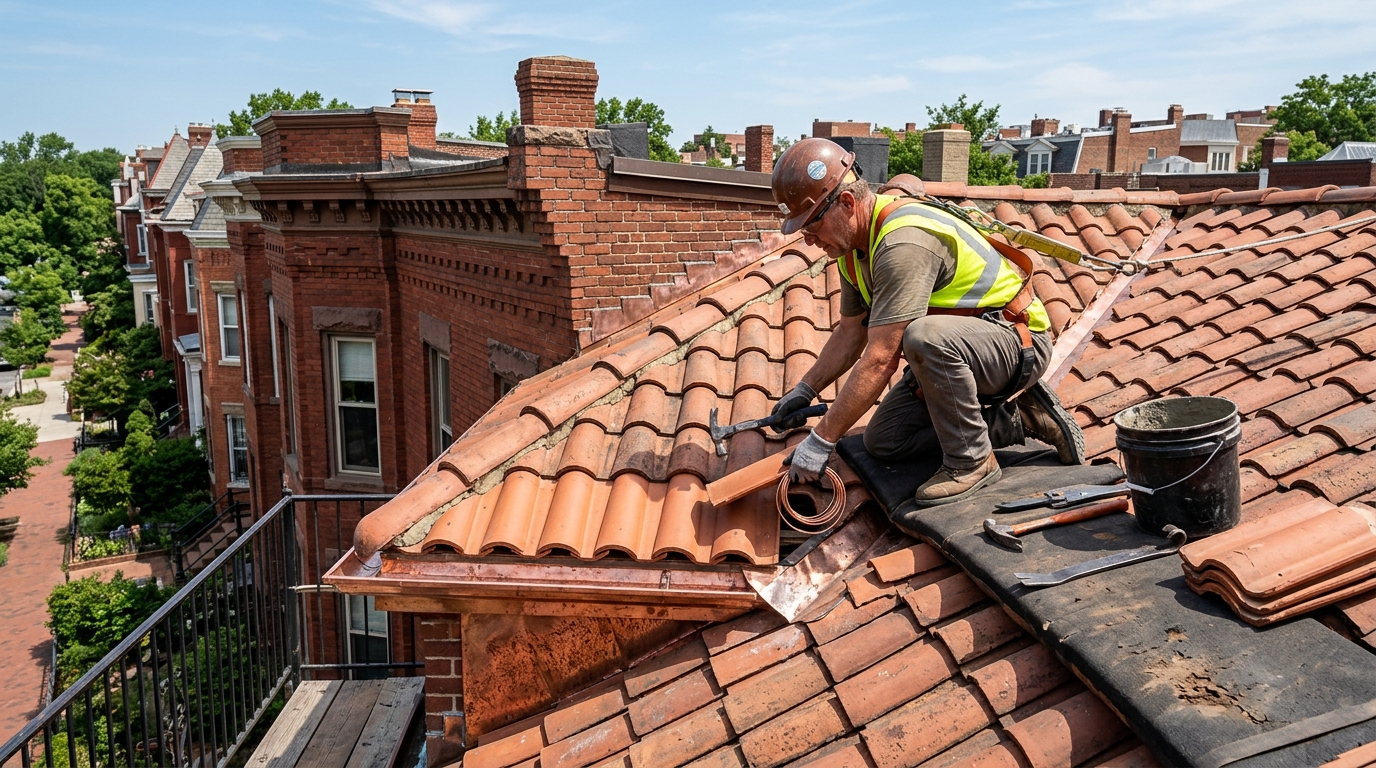
Emergency clay tile roof repair and historic rowhome restoration in Shaw, NoMa & Bloomingdale Washington DC

Historic Clay Barrel Restoration

Precision extraction of cracked clay tiles and installation of matching salvage units on a historic Shaw, NoMa & Bloomingdale roofline.

Tile roof underlayment membrane replacement and copper flashing in Shaw, NoMa & Bloomingdale Washington DC

Underlayment & Copper Rehab

Lifting sound tiles to install high-temperature self-adhering waterproofing membrane and custom copper counterflashing.

Ridge cap mortar repointing and flexible bedding on Shaw, NoMa & Bloomingdale tile roof

Ridge Cap Mortar Repointing

Applying flexible, weather-resistant tinted roofing mortar along hip and ridge courses to stop wind-driven rain leaks.

Tile Roof Repair in Shaw, NoMa & Bloomingdale, DC

Speak directly with a tile roofing specialist who knows the Shaw, NoMa & Bloomingdale area. On-slope assessment, precision tile matching, and documented repair work.

Call (833) 896-1555

DC Tile Roof Repair • 1679 7th St NW #250, Washington, DC 20001