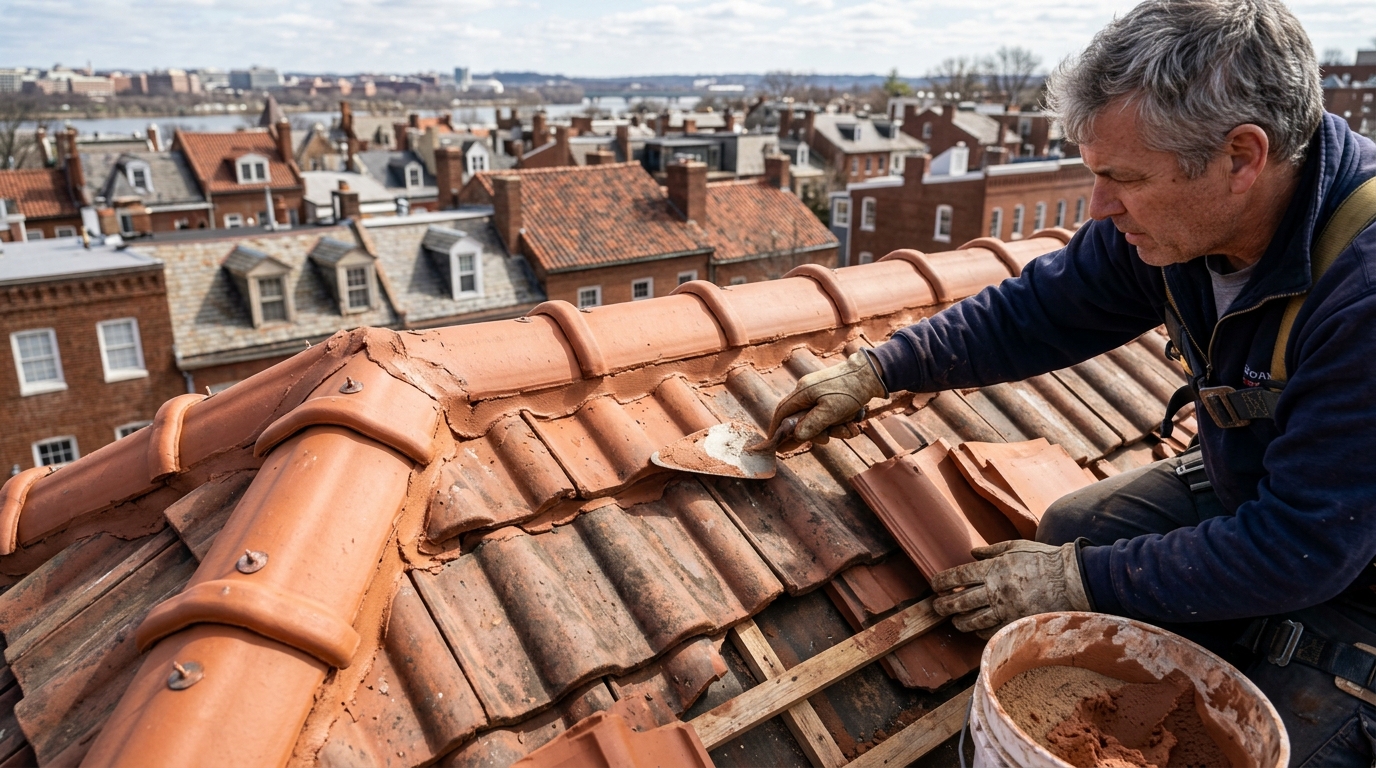
Tile Roof Repair in Georgetown, Glover Park & Foxhall, Washington DC

Georgetown is Washington's oldest neighborhood — predating the District of Columbia itself by decades. Many properties along N Street, O Street, and Prospect Street retain their original 18th and 19th-century clay tile rooflines, governed by the Old Georgetown Act of 1950. DC Tile Roof Repair provides precision tile restoration that satisfies both structural performance and federal historic review standards.

ZIP 20007 ZIP 20057

DC Licensed & Insured

Full liability coverage

Historic Tile Salvage

Vintage & discontinued tiles

Transparent Estimates

Itemized pricing

24/7 Emergency Dispatch

Rapid leak response across DC

Protecting Georgetown's Pre-Civil War Tile Rooflines

Georgetown was established in 1751 — forty years before the federal city of Washington was created around it. The neighborhood's architectural stock spans Federal-period townhomes from the 1790s, Victorian-era mansions from the 1870s, and Tudor Revival estates from the 1920s. Across these distinct periods, clay tile appears consistently as the roofing material of choice for the neighborhood's most prominent residences.

The Federal-period homes along N Street NW and Prospect Street NW often feature flat clay shingle tiles laid in overlapping courses, resembling the European roofing traditions their builders brought to America. Later Victorian additions introduced decorative ridge cresting in copper and ornamental hip tiles with molded profiles. The Tudor Revival homes in upper Georgetown and adjacent Foxhall feature steep cross-gabled roofs with hand-formed English-style clay tiles.

Under the Old Georgetown Act, any exterior alteration visible from a public way requires approval from the Old Georgetown Board and the U.S. Commission of Fine Arts. Tile roof repairs on Georgetown properties must use materials that maintain the established architectural character. Substituting modern concrete tiles for original hand-formed clay is not permitted on designated structures.

Federal Period Flat Clay Shingle Tiles

Georgetown's oldest surviving roofs use rectangular clay shingles laid in staggered courses with copper or lead interlocking clips. Replacement tiles must match the original thickness, edge profile, and natural red-orange firing color.

Tudor Cross-Gable Handmade Clay

Foxhall Village and upper Georgetown estates use hand-formed English-style clay tiles with irregular edges and natural surface variation. These cannot be matched by machine-made tiles — we source from specialty fabricators who produce handmade clay in small batch runs.

Georgetown Service Details

Coverage: Georgetown, Glover Park, Burleith, Foxhall Village, Hillandale, Georgetown University campus
Key Streets: N Street NW, O Street NW, Prospect St NW, Wisconsin Ave NW, M Street NW, Foxhall Rd NW
Regulation: Old Georgetown Act (1950) — Commission of Fine Arts review required for exterior roof changes
Primary ZIP: 20007 (residential), 20057 (Georgetown University)
Call for Georgetown Service: (833) 896-1555

Tile Roof Services for Georgetown Properties

Georgetown requires the highest level of material authenticity and craftsmanship due to its federal historic designation. Our services address every aspect of clay tile preservation.

Old Georgetown Act Compliant Tile Replacement

Every tile replacement on a Georgetown property visible from a public right-of-way must pass review by the Old Georgetown Board. We document the existing tile profile, firing color, edge characteristics, and surface texture, then source replacement units from specialty clay fabricators and historic salvage networks that produce tiles indistinguishable from the originals. Our documentation packages support your permit application and Board review.

  • Material documentation for Old Georgetown Board submissions
  • Sourcing from hand-formed clay tile fabricators
  • Visual compatibility testing before installation
Request An Estimate

Copper Valley & Chimney Flashing

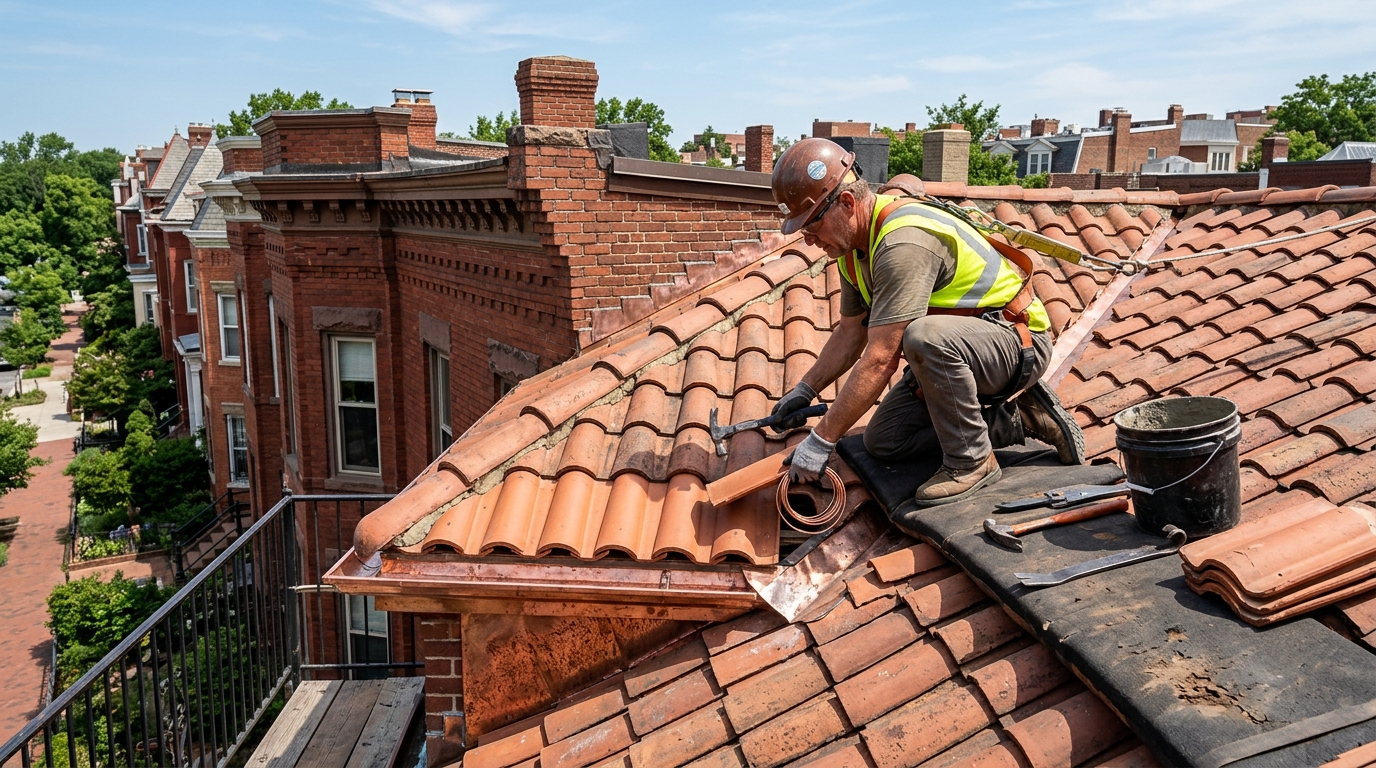
Georgetown's steep cross-gabled roofs create deep valleys where two roof planes converge. These valleys handle concentrated water flow during heavy storms. Many of Georgetown's older homes have original copper valleys that have developed pinhole corrosion after 80 to 120 years of service. We fabricate replacement 20-ounce cold-rolled copper valleys on site using traditional hand-seaming techniques consistent with the property's period construction.

  • Hand-seamed 20oz copper valley installation
  • Chimney cricket fabrication for water diversion
  • Lead counter-flashing set into hand-cut masonry reglets
Request An Estimate

Tile Lift & Reset with Period-Correct Decking

Older Georgetown homes frequently have tongue-and-groove plank decking beneath their tiles rather than modern plywood sheathing. When underlayment renewal requires tile removal, we take care to inspect and repair the original plank decking using compatible dimensional lumber rather than substituting plywood. This preserves the structural authenticity of the roof assembly and ensures proper batten spacing for re-hung tiles.

  • Tongue-and-groove plank decking inspection and repair
  • High-temperature modified bitumen underlayment
  • Original tile cataloging and reinstatement
Request An Estimate

How Georgetown's Mature Tree Canopy Impacts Tile Roofs

Georgetown has one of the densest mature tree canopies in Washington, D.C. Towering oaks, elms, and sycamores line residential streets like 34th Street NW and Dumbarton Street NW, providing welcome shade during summer but creating specific maintenance challenges for tile roofs below.

Heavy leaf fall accumulates in tile valleys and behind dormers, forming organic debris dams that trap standing water against tile surfaces. Standing water accelerates moss and lichen colonization — organisms that produce mild carbonic acid as they feed on mineral content in clay tiles. Over years, this biological attack pits the tile surface, opening micro-pores that allow moisture penetration and freeze-thaw spalling.

Large overhanging limbs also drop branches during storms. Unlike asphalt shingles that dent and recover, a clay tile shatters on impact. A single fallen limb can fracture multiple tiles across a slope, requiring immediate replacement to prevent water from reaching the underlayment.

Georgetown's proximity to the Potomac River adds another dimension. The elevated humidity near the waterfront combined with canopy shade creates conditions where tile roofs on the lower streets dry slowly after rain. Persistent dampness accelerates copper oxidation on valley pans and ridge crestings, shortening the service life of metal components.
Georgetown-Specific Tile Failures

Moss-Induced Surface Pitting Biological growth under heavy tree canopy produces carbonic acid that etches into clay tile surfaces, creating moisture-trapping micro-pores.
Branch Impact Fractures Overhanging oak and elm limbs drop during storms, shattering multiple clay tiles on impact across the slope below.
Valley Debris Damming Accumulated leaf litter creates standing water pools in tile valleys, overflowing onto underlayment beneath tile overlaps.
Potomac Humidity Copper Corrosion Elevated riverside moisture accelerates verdigris patina and eventual pinhole corrosion on copper valleys and ridge crestings.

Tile Roof Repair Questions for Georgetown Homeowners

Do I need Old Georgetown Board approval to repair my tile roof? +
If your property falls within the Old Georgetown Historic District and the repair work is visible from a public right-of-way, the Old Georgetown Board (operating under the U.S. Commission of Fine Arts) reviews exterior alterations. In-kind tile repairs using matching materials typically receive streamlined approval. We provide material documentation — including tile manufacturer, profile dimensions, firing color samples, and photographs — to support your review application.
Can you source replacement tiles for a Federal-period Georgetown townhome? +
Federal-period Georgetown homes from the late 1700s and early 1800s use flat clay shingle tiles that are no longer mass-produced. We work with specialty clay fabricators who produce small-batch handmade tiles fired in traditional wood kilns to replicate the irregular edges, natural color variation, and slightly bowed surface of period tiles. We also maintain connections to regional architectural salvage dealers who occasionally recover original Federal-era clay tiles from demolition and renovation sites.
How often should Georgetown tile roofs be inspected given the tree canopy? +
Properties under heavy canopy in Georgetown — particularly along the 3100-3500 blocks of N, O, and P Streets NW — benefit from annual visual inspection after autumn leaf fall. The primary concern is organic debris accumulating in valleys and behind dormers, creating moisture traps. Early detection of moss colonization and valley blockages prevents the cascading damage pattern of surface pitting, trapped moisture, freeze-thaw cracking, and eventual underlayment failure.
What distinguishes your copper valley work from standard roofing contractors? +
Standard roofing contractors typically install pre-formed aluminum or galvanized steel valleys. On Georgetown's historic tile roofs, we use 20-ounce cold-rolled copper formed on site using hand-seaming techniques. Copper is specified because it develops a natural verdigris patina that complements clay tile aesthetics and provides a service life exceeding 80 years. Our hand-seamed joints eliminate the risk of sealant failure that plagues mechanically-fastened valley systems.
How do I get an estimate for Georgetown tile roof repair? +
Call our Washington, D.C. office at (833) 896-1555. Georgetown properties often have complex roof geometries with multiple valleys, dormers, and hip intersections that require hands-on evaluation. Our specialist will coordinate an on-slope assessment and provide an itemized estimate covering tile replacement, mortar work, flashing, and any underlayment renewal needed.

Tile Roof Restoration & Emergency Fieldwork

View our technicians performing precision tile salvage, underlayment renewal, and copper metalwork across Georgetown, Glover Park & Foxhall and Washington, D.C.

Emergency clay tile roof repair and historic rowhome restoration in Georgetown, Glover Park & Foxhall Washington DC

Historic Clay Barrel Restoration

Precision extraction of cracked clay tiles and installation of matching salvage units on a historic Georgetown, Glover Park & Foxhall roofline.

Tile roof underlayment membrane replacement and copper flashing in Georgetown, Glover Park & Foxhall Washington DC

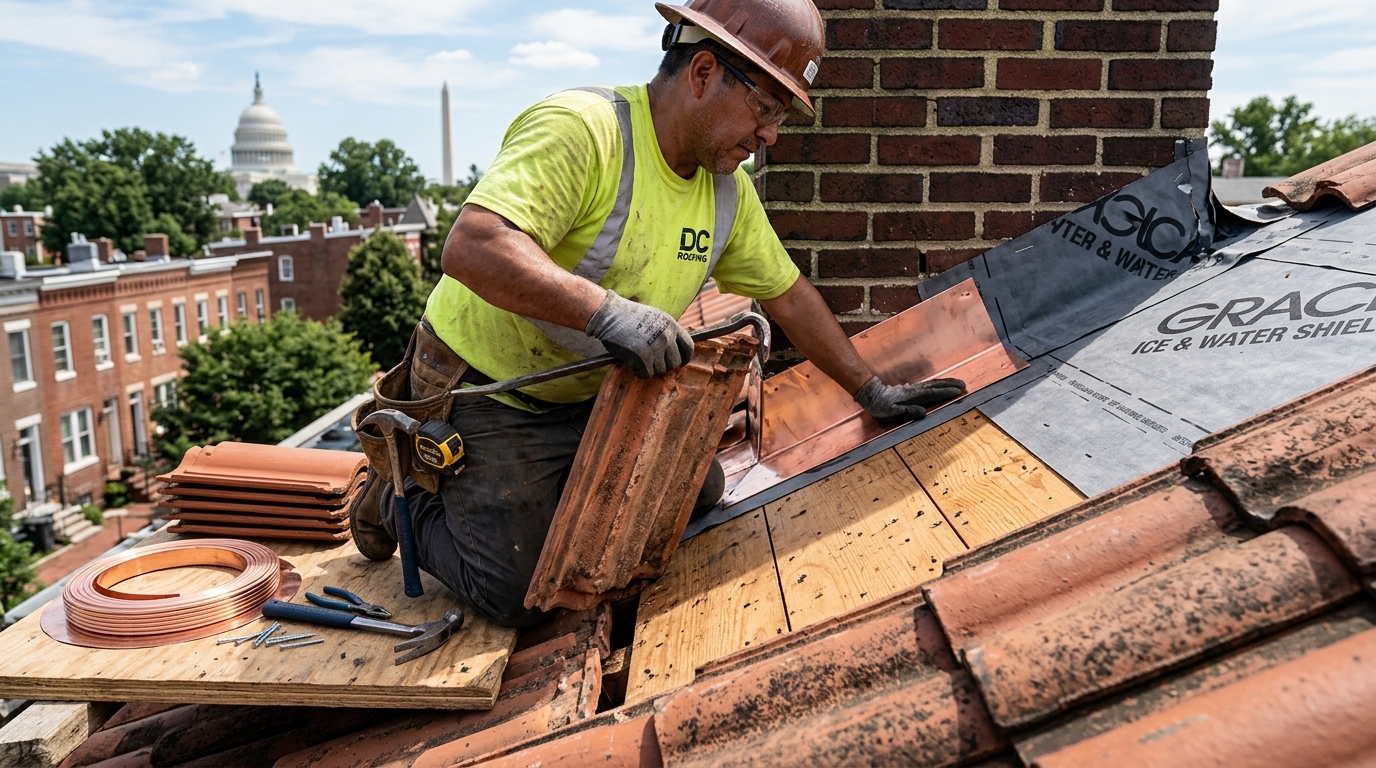
Underlayment & Copper Rehab

Lifting sound tiles to install high-temperature self-adhering waterproofing membrane and custom copper counterflashing.

Ridge cap mortar repointing and flexible bedding on Georgetown, Glover Park & Foxhall tile roof

Ridge Cap Mortar Repointing

Applying flexible, weather-resistant tinted roofing mortar along hip and ridge courses to stop wind-driven rain leaks.

Tile Roof Repair in Georgetown, Glover Park & Foxhall, DC

Speak directly with a tile roofing specialist who knows the Georgetown, Glover Park & Foxhall area. On-slope assessment, precision tile matching, and documented repair work.

Call (833) 896-1555

DC Tile Roof Repair • 1679 7th St NW #250, Washington, DC 20001